Commercial Roof Repair and Restoration in Cypress, TX
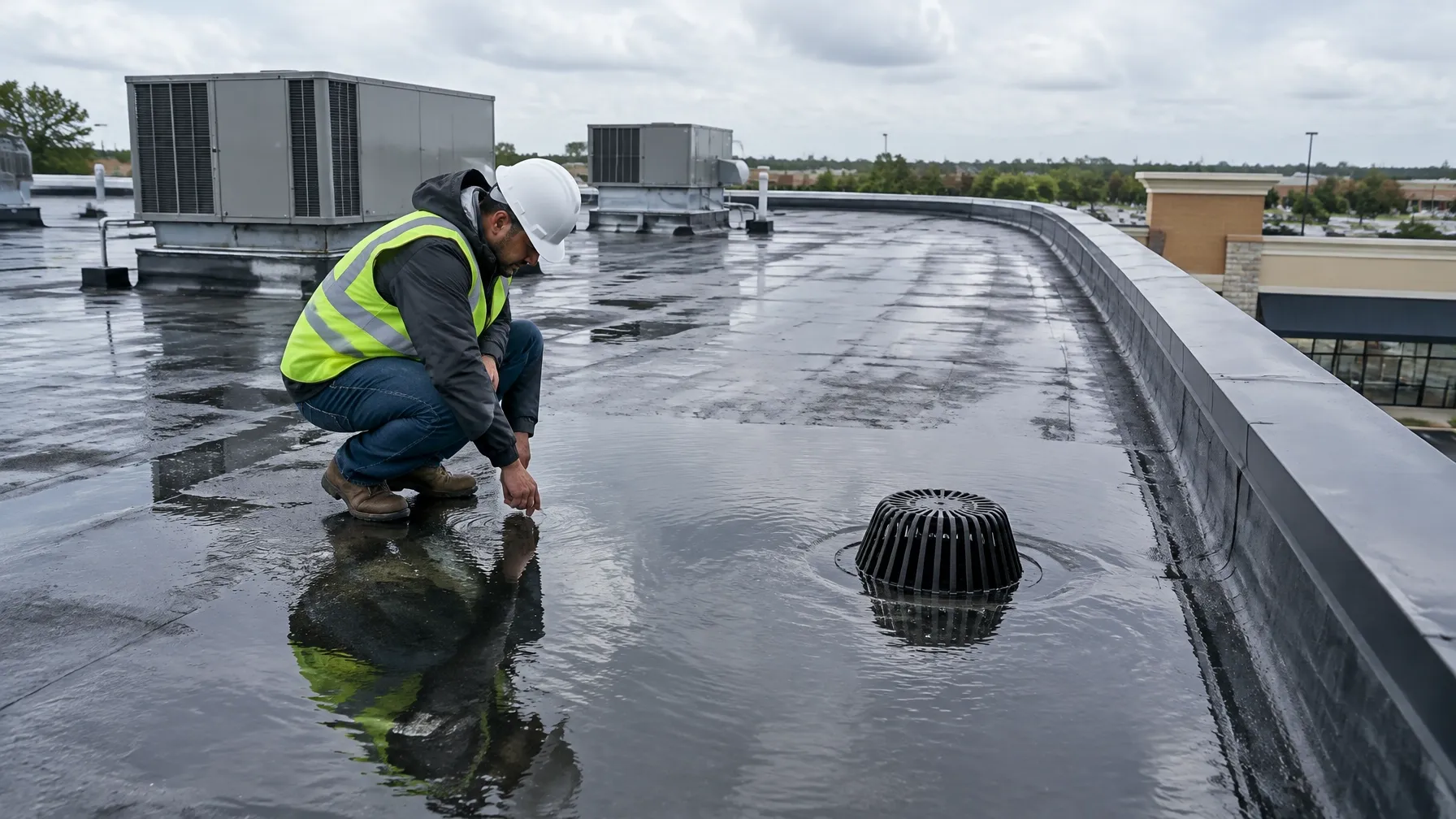
Flat roofs along the 290 corridor do not fail all at once. They fail where water sits, and a repair that ignores the water will not last.
Cypress, TX
Cypress commercial corridors along US 290 and the Grand Parkway are built on flat ground. Retail centers, medical office parks, and multi-tenant office buildings here share the same drainage reality: long, low-slope roof runs with internal drains or scuppers, and very little fall. When a low spot develops or a drain slows down, water sits on the membrane. Ponding water turns small defects into active leaks. It accelerates seam wear, loads the deck, and keeps any opening wet long enough to let water inside. On retail and medical roofs, that leak usually shows up over tenant space, exam rooms, or leased suites where the cost of disruption is high. That is when a repair scope matters, and it is why the diagnosis has to come before the patch. Primetime Roof Coatings & Restoration approaches Cypress roofs diagnostically. We document where water is sitting, why it is sitting there, and what the membrane around it can still do. If the problem is one drain, one curb, or one seam, the answer is a targeted repair. If wear and ponding history are spread across the whole field, the assessment will show when restoration is the more economical path.
Why Cypress ponding needs a diagnosis, not another patch
- Drainage-first diagnosis: We identify low areas, blocked drains, and slope problems first, because a repair under standing water will not last.
- Repairs with equal substance: A defined repair on a serviceable roof is often the most cost-effective answer, and we scope it with the same documentation as any larger project.
- Tenant protection: Retail and medical roofs are repaired around business hours, inspection access, and leased-suite schedules.
- Maintenance planning: Findings and photos become a year-over-year record owners can use to budget instead of reacting.
- Restoration when it fits: If wear is field-wide but the assembly is sound, a coating system restores the roof in place, often at up to 50% less than replacement.
What we check on a Cypress commercial roof
Every Cypress assessment walks the same checklist:
- Ponding maps: where water sits, how long it stays, and whether slope or drainage is the cause.
- Drains, scuppers, and gutters for blockage, sizing, and overflow capacity during heavy Gulf rain.
- Seams, flashings, and curbs in the areas ponding affects most, which fail before the field does and drive most repair calls.
- Membrane flexibility and surface wear, to judge whether isolated repair or broader restoration fits.
- Interior evidence, tracing stains and travel paths back to the roof-level source over tenant or clinical space.
Repair, restoration, or replacement in Cypress
The assessment separates three levels of scope:
- Targeted repair: Right when a specific drain, curb, or seam is the problem and the surrounding membrane is still flexible and attached. This is a complete answer, not a temporary one, when the diagnosis supports it.
- Restoration: Right when ponding history and surface wear are spread across the roof. A coating system fills minor irregularities and renews the surface without tear-off. Explore elastomeric roof coating.
- Replacement: Right when saturated insulation, structural loading, or unresolved slope design makes the assembly unsaveable. We document why.
Cypress context: retail centers and medical parks along 290
Cypress commercial inventory is dominated by retail centers, medical and professional office parks, and neighborhood service buildings. These roofs share three things: large square footage, tenant-facing operations, and drainage designed for a flat coastal plain. Repair-first planning matters more here than on a single-tenant warehouse. A documented assessment gives a property manager a defensible record for owners, a defined repair scope to hand to a general contractor during a remodel, and a comparison point when a storm claim or a capital reserve study comes up. It also shows clearly when a roof has moved past repair and restoration would protect the budget better. If water is already inside a tenant space, start with our emergency roof leak repair page, then use the assessment findings to plan the permanent fix.
FAQ
Why does my Cypress flat roof pond water after every rain?
Houston's coastal plain has very little natural fall, so long roof runs depend on accurate slope and clear drains. Settlement, blocked drains, and compacted insulation create low spots. We map every ponding area and identify the cause before recommending work.
Can ponding areas be repaired without replacing the roof?
Usually yes. If the membrane around the ponding area is still flexible and attached, we can correct the detail, improve drainage where practical, and, when wear is field-wide, restore the surface with a coating system designed for low-slope roofs.
How do you work around tenants in a Cypress retail or medical center?
We schedule access around business hours and tenant operations, keep the work area contained, and sequence the roof in sections so suites stay open. Most coating projects are completed in days rather than weeks.
When does repair stop making sense on a Cypress roof?
When defects and ponding damage are spread across the field, repeated repairs become the expensive path. If the insulation and deck are still dry and sound, restoration renews the roof in place. If the assembly is saturated or detached, replacement is the honest answer. The assessment draws that line with evidence.
Helpful resources
Request a Commercial Roof Condition Assessment for your Cypress property: a defined repair scope for the failure, or restoration if the roof qualifies. Call 832-447-1170.